Renters mount TVs all the time. The ones who get their full deposit back do three things first: read the lease, keep the holes few, and learn what the building’s walls are made of.
1. Read the lease
Look for words like “alterations,” “nails,” “wall hangings” or “mounting.” You will usually find one of three answers:
| The lease says | What it means | What to do |
|---|---|---|
| Allowed | Often with a line that holes must be repaired at move-out | Mount it, keep the paint color name for touch-up |
| Allowed with permission | The landlord wants to know before you drill | Send a short email and keep the reply |
| Not allowed | No drilling without consent | Ask anyway; many landlords agree to a professional install that is patched at move-out |
| Nothing about walls | The general rule on alterations and damage applies | Ask in writing before you drill |
Whatever the answer, get it in writing. An email is enough. Leases and local rules differ, so if the wording is unclear, the landlord’s written reply is what counts.
An email you can send
Hi [name], I would like to wall-mount a TV in the living room of [unit]. A professional installer will bolt a bracket into the wall studs (four to six small holes) and run the cables in a removable cover on the surface, so nothing is cut open. I will fill and paint the holes when I move out. Is that okay with you? Thanks, [your name]
Short, specific and easy to say yes to. It tells the landlord exactly what will be left behind, which is usually their only worry.
2. Keep the holes few and small
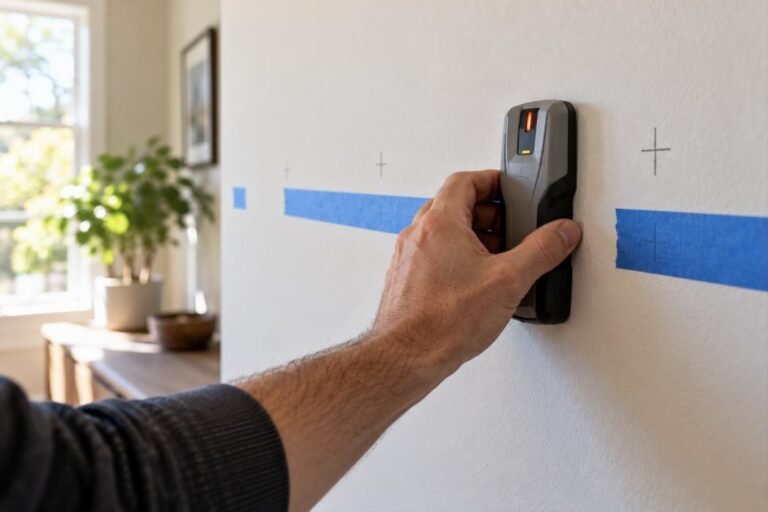
A fixed or tilting mount needs four to six holes, all in the studs. That is the easiest repair there is: filler, a light sanding and a dab of paint.
For the cables, choose a cord cover on the surface over cutting into the wall. It comes off without a trace. The reasons are in how to hide TV wires.
- Skip the full-motion arm unless the room needs it. It loads the wall more and is the mount most likely to leave marks.
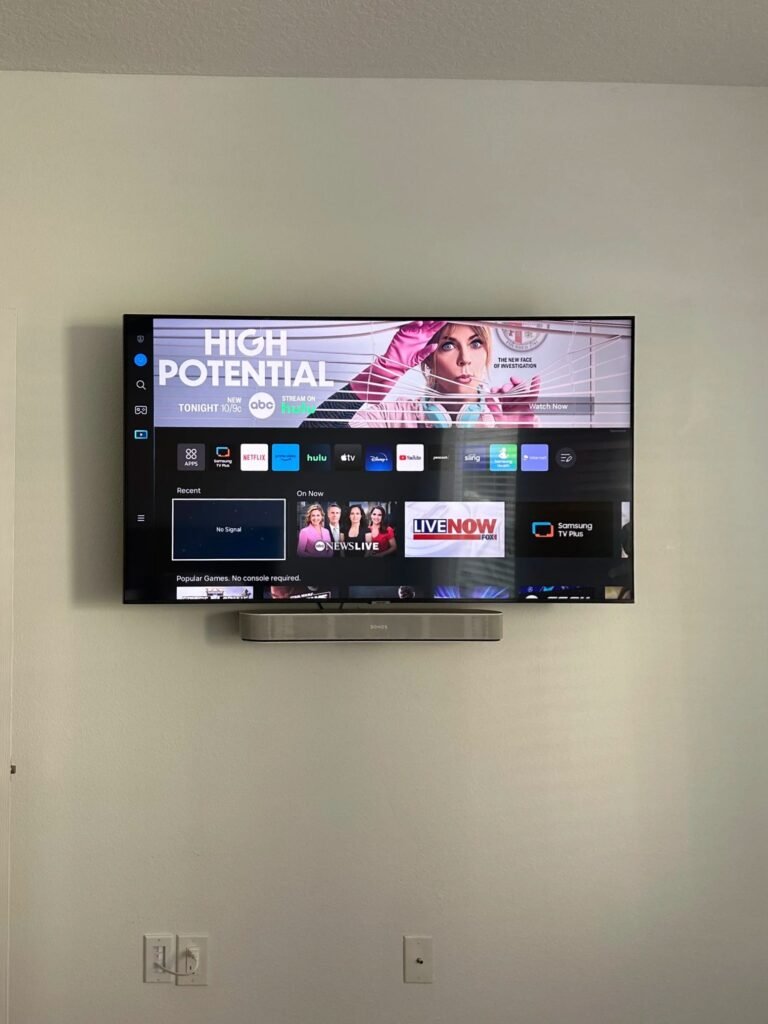
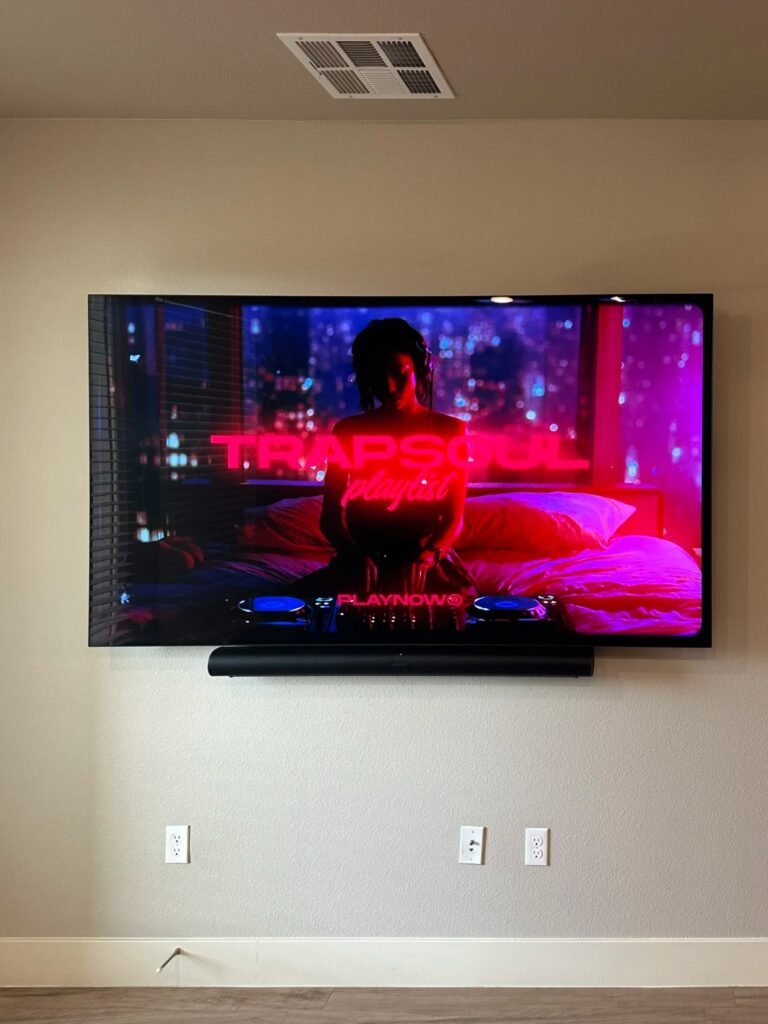
- Add a soundbar with care. Fixed to the wall it means more holes; attached to the TV with a bracket it means none.
- Photograph the wall before the install. It shows the condition you started from.
3. Know your building
Apartment and condo buildings often have metal studs or concrete walls. Both hold a TV well with the right anchors, and both need to be known in advance. Some buildings also have rules about work hours or require the installer’s insurance certificate. A quick question to the front desk saves a wasted visit. How to tell the wall types apart: what holds a TV.
One more thing to ask about in a shared building: what is on the other side. A wall that backs onto a neighbor’s unit or a bathroom may have pipes or shared wiring in it, and drilling into a concrete party wall is noisy enough to need the right hour of the day.
When you move out
- Take the TV and the mount with you — the mount is yours.
- Fill the holes with spackle, sand once dry and touch up the paint.
- Take a photo of the repaired wall for your records.
Lag-bolt holes are wider than nail holes, so fill them in two passes: the first one shrinks as it dries. Touch-up paint only blends in if it is the same paint and sheen, which is why it is worth asking the landlord for the color at the start.
If drilling is truly off the table
A floor stand with a mounting pole gives the same look without touching the wall. It costs more than a wall mount and takes floor space, but it moves with you. Some media consoles come with a built-in mounting post that does the same job. If the TV stays on its own feet, strap it to the wall or the furniture with an anti-tip strap — that matters most in a home with small children.
Common questions
How big are the holes from a TV mount?
About the width of a pencil, four to six of them, in a patch of wall smaller than the TV itself. They are hidden behind the screen for as long as the TV is up.
Will a cord cover damage the paint?
An adhesive cover can lift paint when it is pulled off. Warm it with a hair dryer first and peel slowly, or ask for the cover to be fixed with small screws instead; the holes are easier to repair than torn paint.
Can the landlord say no?
That depends on the lease and on local rules, and we cannot answer it for your building. In practice a clear written request, like the email above, gets a yes far more often than people expect.
Do you patch the wall when I move?
Removing a TV and mount is a service we offer; the patching and painting are yours or the building’s. Ask when you book and we will tell you what is included.
Get a price for your TV — name and number first, then a few quick questions. It takes about a minute.